Quantcast
Channel: Aconex – Extranet Evolution

TonicDM competes in PIM space

$
0
0

AECbytes‘ Lachmi Khemlani has written an interesting and detailed review of a US-developed Software-as-a-Service project information management solution (PIM) called TonicDM. (She distinguishes between PIM and project management solutions, such as Oracle Aconex, Procore, etc: “The basic difference is that PIM manages the large volumes of information associated with a project, whereas PM manages the actual project—its design and construction—itself.”)

Based in Los Angeles, California, TonicDM was founded TonicDM logoin 2016 by a former Gehry and Gensler executive Reg Prentice (now CEO) and a technologist, now CTO, Chris Pinckney (whose recent history includes spells at Riverbed and RedSky – the latter is now part of Presidio, and not to be confused with UK-based construction software vendor RedSky IT). The TonicDM solution – the DM comes from ‘document management’ – was born out of Prentice’s experiences with Newforma’s PIM product Project Center while at Gensler (the Newforma application started as an on-premise solution, and only later added cloud connectivity to its capabilities – post).

TonicDM aims to be “simple and easy”, and is tightly integrated with Microsoft’s Outlook email application (and the rest of the Office 365 ecosystem). It manages and tracks transmittals of large files, and has an RFI and submittal management system customised to the needs of design teams (with Procore and email integrations to manage contractor communications). Prices start from US$15 per user per month; the RFI and submittal management comes in a contract administration (Standard + CA) package costing US$30 per user per month. According to Khemlani, TonicDM is also beta-testing a NLP (natural language processing) capability to undertake sentiment analysis on emails and gain deeper insights into projects (the second time in a week I’ve heard NLP mentioned; it is also something being explored by Viewpoint – post).

How simple and easy TonicDM remains is open to question. Once solutions start to become embedded in users’ organisations, demands for new features start to grow, as do calls for wider integrations with other platforms used either by the users or by other organisations their firms are working with. And, as with other solutions that are document-centric, I also wonder about their long-term applicability when projects involve building information modelling and wider digital collaboration.

Update (2 June 2019) – The team at TonicDM has responded to this blog post with a post of their own.

The post TonicDM competes in PIM space appeared first on Extranet Evolution.


Melbourne start-up Matrak attracts interest

$
0
0

Australian construction technology startup Matrak is attracting a lot of interest, having just raised Au$3 million in new funding.

Matrak logoMelbourne, Australia-based construction technology startup Matrak is attracting a lot of interest, particularly after being described (by a former Aconex chairman) as the next potential Australian contech “unicorn” following the success of Aconex (acquired by Oracle for US$1.2 billion in December 2017).  Matrak has just raised Au$3 million in new funding.

Matrak back story

Matrak is a construction workflow management application that helps suppliers and site-based installation teams track the manufacture, transport, delivery and installation of building components (read more in this SmartCompany article). It was developed by co-founders and brothers Shane and Brett Hodgkins, after Brett, a computer science graduate, worked on a window installation project for his father’s business in 2013. Paper dockets were then the only way to track what had been sent to site, so Brett developed a prototype mobile application which attracted interest from both the window manufacturer and the main contractor working on the project. Brett talked to Shane (also working in software development) about scaling the application, and the two bootstrapped Matrak for two years before officially launching the product in November 2016 and going full-time on the system.

Having secured customers in Australia and China, plus a first US customer, the company raised Au$765,000 in seed funding (well in excess of the Au$450,000 target) in August 2018, with a large investment coming from former Aconex chair Simon Yencken. By this stage, the app had tracked around Au$4 billion worth of construction materials. Less than a year later (2 July 2019 – read AFR article), Yencken has led a further funding round which has pumped Au$3m into Matrak.

Network effects

Construction Sector Deal coverYencken is apparently attracted by the same “network effects” which led to Aconex’s explosive growth: “In Matrak’s case, they win one builder and instantly the app is going to be in the hands of hundreds of suppliers.” He also welcomes the solution’s adoption by dozens of Chinese suppliers to the Australian building industry, who can take photos and scan QR codes provided by the app to verify their work. The  new investment round will help Matrak to double its current headcount of 13 this year, and to automate more of the app’s features. The solution is currently offered on both the Apple iOS and Google Android platforms.

In my view, such applications may also interest firms involved in projects deploying offsite manufacturing approaches. First mooted in December 2017, five UK government departments have adopted a presumption in favour of offsite construction, and the July 2018 Construction Sector Deal underlined the strategic importance of digital techniques and offsite manufacturing technologies.


The post Melbourne start-up Matrak attracts interest appeared first on Extranet Evolution.

Atvero: Office 365 SharePoint-based PIM

$
0
0

Many AEC firms use Microsoft SharePoint application internally. Now a cloud-based tool, it is the foundation of a new UK-developed solution, Atvero.

Atvero logoA new Microsoft SharePoint-based project information management (PIM) solution, Atvero, was launched at the Royal Institute of British Architects in London today (10 September 2019). Developed in just over a year by a small team of developers at London-based IT and consultancy services provider Nittygritty, Atvero is positioned as providing a cloud project delivery capability for design and construction professionals.

Paul Daynes of AtveroThe launch event was fronted by Paul Daynes, right, formerly at Newforma UK (post), and he differentiated Atvero from traditional on-premise database-driven information platforms and index-based platforms (such as Newforma). He said:

“We are very excited about the possibilities and opportunities for improvement that Atvero will provide to the industry. In a digital age, design and construction companies that have or are looking to migrate to cloud strategies, will benefit hugely from Atvero – increasing efficiency, improving quality and reducing risk in project delivery. Atvero is unique, it’s modern and presents a smarter way to manage project deliverables and communication, when compared with on-premise PIM solutions.”

At the launch, Microsoft consultant Andy Talbot talked about the depth of collaborative capabilities built into the Microsoft 365 platform – notably using OneDrive, Teams and SharePoint, but also bringing in wider Office tools, including Outlook and Yammer, and some 140 integrations with other vendors’ solutions. These capabilities deliver Team, Communication and Hub sites for intranets, and are today accessible across multiple devices. “SharePoint has a new lease of life,” he said (perhaps conscious that some people – like me – have had poor past experiences of the original manifestation of SharePoint).

Atvero – augmenting SharePoint

Atvero Sharepoint plusNittygritty’s operations director Liam Southwood was somewhat less positive about SharePoint (“… in terms of it’s document management capabilities, it doesn’t really offer much more than Dropbox”), underlining that Atvero was developed to add new areas of AEC-focused capability (right). He described how it integrated with Autodesk products such as Revit and AutoCAD, plus graphics tools from Adobe. It also has the potential to share information with other collaboration products (his slide showed links to AEC platforms including Autodesk’s BIM 360, Oracle Aconex, Trimble’s Viewpoint For Projects and GroupBC). Southwood said the platform could manage file naming (a la BS 1192:2007), and had powerful versioning and revision control. A project portal can also be created to share information with external partners, creating issue sheets and the like. An Outlook plugin in Atvero also allows tight email integration “to lighten that pain”. In a live demonstration, he showed how a Revit plugin for Atvero can “reconcile Revit revisions in compliance with BS 1192/ISO 19650”, support approval processes, create standard issue sheets, and issue model files in DWG, DWF and PDF formats.

Daynes outlined future plans including further enhancements to core functions, integration with Autodesk’s BIM360/Forge tools and markup using Bluebeam. 2020 aspirations include project accounting integrations, and support for ISO 19650 CDE information workflows. Integrations with other SaaS extranet/CDE platforms are possible, Southwood added, dependent on functional requirements and API access. The product is licensed at £16 per user per month, with initial consultancy costs of around £2,500, but negotiable depending on the size of the customer firm, Daynes said.

Customer adoption

London-based architectural firm Chapman Taylor has been using Atvero for some months and plans to roll out the platform more widely later this year (it has 455 staff in 17 offices around the world). Andy Hudson, a director at the firm, said the firm has been using Union Square (acquired by Deltek in July 2016) but is in the process of transitioning to a SharePoint-based platform (he also said the firm had painful experience of retrieving information previously shared via the Viewpoint For Projects system after the liquidation of Carillion). It had lots of Office 365 licenses and wanted to leverage its investment; originally, SharePoint couldn’t provide the document management requirements of the firm, but, over the past 18 months, Atvero has given the business those capabilities. All internal management of its UK projects will be via the SharePoint-based platform by the end of 2019, he said. Hudson also provided an Atvero endorsement:

“Atvero PIM provides Chapman Taylor with a modern and scaleable project information management solution that meets our business needs for the next decade and beyond. For Chapman Taylor to be competitive, win and deliver more successful projects, we need a platform that gives us flexibility, but also rigour in our project delivery processes. Atvero PIM offers us this capability.”

Liam SouthwoodDaynes said Atvero enabled firms to move from existing on-premise solutions – including 28Hands’ Mail Manager, Deltek PIM and Newforma – to a cloud-based Sharepoint platform. This can be hosted by Microsoft in region-specific locations, helping firms meet clients’ data sovereignty requirements.

Architecture-trained, Southwood, right, believes Microsoft, Autodesk and Adobe are the “holy trinity” of providers for the AEC sector, but also recognises that some firms may be using other vendors’ tools: Bentley products, ArchiCAD, Vectorworks, etc. When it came to interoperability between solutions, IFC wasn’t mentioned in the presentations, but Southwood said Atvero used Microsoft tools which were format-agnostic, so IFC models could be manually shared using the platform, and didn’t rule out his team developing more integrated IFC export capabilities if customers required them.

Extranet Evolution view

The SharePoint application connects multiple Microsoft products, and perceptions about it have changed since its transition from an on-premise product to being a cloud-based tool. Previous SharePoint-based AEC solutions (Organice’s Cadac, for example) were based on the on-premise system, but Atvero is looking to capitalise upon the reinvigorated product to provide, effectively, a cloud-based intranet for AEC design and construction firms.

This is not the only solution of its kind. Another developer, US-based Simplex Group, launched its VPO Cloud (‘virtual project office’) to customers wanting construction management software in the Microsoft Cloud in 2017 (read VPO: Microsoft 365-based project management); TonicDM (post) is also tightly integrated with the Microsoft Office 365 ecosystem. Such tools will help organisations still working predominantly with traditional 2D drawings and other construction deliverables (and this remains the case, even in the UK – at the CDBB Digital Twin Day yesterday [9 September 2019] it was said that 62% of projects are still mainly designed in 2D), but the demands of BIM and creating a common data environment require additional capabilities. With the UK continuing to push forward with BIM and data-driven approaches, Atvero clearly has to integrate with CDE platforms and workflows.

The almost universal adoption of Microsoft Office products across the AEC market has made integration with Microsoft a common requirement for other AEC tools. Outlook plugins have been a long-standing feature of many SaaS collaboration platforms and CDEs, and some vendors have pushed the relationship still further. Since 2013 (post), Bentley Systems has been nurturing a strong relationship with Microsoft using Azure to support its “connected data environment” (among others, Germany’s RIB has a similar relationship – post), and in October 2018 Bentley announced general availability of its integration between ProjectWise 365 Services and Microsoft 365 (post).

Mention of Bentley also raises a question about Atvero’s focus on Autodesk’s design authoring tools as a basis for its platform. While this might be valid for architectural firms and others involved in conventional buildings and structures, Atvero is not catering for many potential customers who work primarily in civil engineering / infrastructure projects. Also, other design authoring platforms are favoured in some marketplaces (in central Europe, Asia, etc), while Autodesk’s new subscription model has antagonised some customers who have then been tempted by lookalike products such as BricsCAD from Bricsys (acquired by Hexagon in October 2018 – post).

The post Atvero: Office 365 SharePoint-based PIM appeared first on Extranet Evolution.

thinkproject acquires German CDE specialist Conclude

$
0
0

Construction and engineering SaaS provider thinkproject has acquired fellow German CDE specialist Conclude, adding 5D BIM capability to the group’s portfolio.

thinkproject logoMunich-based Software-as-a-Service construction collaboration technology provider thinkproject has acquired 100% of fellow German common data environment (CDE) specialist Conclude GmbH (read announcement). No deal value has been disclosed.

Conclude logoBased in Wuppertal near Dusseldorf, Conclude has a strong asset-owner customer base, plus extensive expertise in project cost management . Thinkproject says the acquisition broadens its customer base, as well as offering additional capabilities to owner-operators and general contractors within the group’s product portfolio.

Conclude has specialised in SaaS applications and supporting services for major construction and engineering projects since 2002. It draws on expertise developed at Dortmund’s Fraunhofer Institute for Software and Systems Engineering. The Conclude platform currently has over 100,000 users working on over 2,000 projects, with a total capital value of more than €300 billion (c. £270bn or US$330bn) in 38 countries. Blue-chip customers include ABB, BMW, Continental, Mercedes, Roche, Siemens and UBS.

Conclude’s suite includes more than 25 application modules; e.g. tools for BIM, design and document management, common industry workflows and reporting functions, and importantly – cost management.

thinkproject Concludes deal

After succeeding founder Thomas Bachmaier in May 2019, thinkproject CEO Gareth Burton says:

Gareth Burton (think project! CEO)“We continue to execute our strategic plan to become the leading Construction Intelligence platform for asset owners and general contractors. thinkproject has leading BIM capabilities for both design (3D) and project schedules and sequencing (4D). By acquiring Conclude, we enhance our cost management with a leading cost management solution, offering further 5D capability to the group product set, while deepening our relationships with major international asset owner-operators delivering some of the world’s most demanding engineering and construction projects.”

Conclude cost controlConclude was founded by Drees & Sommer, Marco Lehmbach and Peter Kaul to offer innovative and practical software tools for demanding construction projects. Conclude founder and managing director Lehmbach says:

“Our clients will benefit from the strong international presence and broad product portfolio of thinkproject, including BIM, contract management and mobile technologies. Indeed, this product portfolio complements very well our platform. The combined 5D solution will be even more attractive to our existing customers, and an even more compelling offer to new customers, particularly owner-operators looking to optimise whole life asset value.”

Kaul adds:

“We are delighted to become integrated within thinkproject. Conclude will benefit from the experience and structures of thinkproject’s international business. Our joining forces has created a strong an even stronger solution for digital transformation which will further support our customers both in Germany and worldwide.”

Thinkproject says the two companies share a strong belief in SaaS and the virtues of ‘open BIM’: creating and maintaining interoperable software solutions where the data is not hindered in proprietary formats – an important capability when owners will need to reuse information throughout the life cycles of their built assets.

Steffen Szeidl, member of the management board of funding partner Drees & Sommer SE, said:

“Conclude was our first start-up where we turned our joint business ideas into IT solutions. To grow further in international markets and appeal to new customer segments, we decided to sell our share. We are delighted to join thinkproject, Europe’s leading construction and engineering SaaS provider. We will, of course, continue to champion the use of Conclude in our projects over the coming years.”

Burton continues:

“Following on from the March 2019 acquisition of ceapoint GmbH and its DESITE 4D BIM toolset, the thinkproject group has now been additionally strengthened by Conclude’s ca. 40-strong specialist team in Wuppertal, which brings even more best practices experience and resources to our teams. As BIM adoption continues to grow around the globe, we believe our expanded suite of open, integrated SaaS solutions will be increasingly attractive to a growing number of international customers across the built environment lifecycle.”

The Extranet Evolution view

In a building information modelling (BIM) context, this deal adds 5D capability to (freshly rebranded – news release) thinkproject’s SaaS product portfolio, complementing the UK-developed CEMAR contract management functionality added in May 2018 (post), and will make it more competitive against platforms already offering 5D functionality. The deal will also help fulfill thinkproject’s 2019 ambitions to grow both organically and by acquisition (see think project! set to expand).

Most notably in a German context, these competitors include RIB Software (which has been busy building its international reach, with 2019 deals in India, South Africa, the US and the UK, while aiming to grow its SaaS user base ten-fold in 2019) but also the US’s Oracle Aconex (see Connected Cost – Aconex’s game-changer?), Autodesk (see Autodesk BIM360 embracing 5D) and Trimble Viewpoint (see What next for Trimble’s SaaS platforms?) and Viewpoint launches ViewpointOne strategy).

Drees & Sommer employed Ralf Händl who in January 2014 took over as CEO of the Anglo-German SaaS construction collaboration technology provider Conject (see Ralf Händl takes over at Conject), in March 2016 acquired by Aconex (see Aconex acquires Conject). The thinkproject deal marks further consolidation in the European SaaS CDE market just as BIM becomes increasingly important as the foundation for digitalisation of the sector. The apparent adoption of Conclude by owner-operators is a another plus point in a still cost-conscious industry where leading players are increasingly talking about Industry 4.0 and digital twins (see Bentley pushes ‘Digital Twin’ into AEC mainstream).

[* Disclosure: I have provided marketing consultancy services to thinkproject.]

The post thinkproject acquires German CDE specialist Conclude appeared first on Extranet Evolution.

Towards connected data environments (CDEs)

$
0
0

CDEs? As BIM standards begin to emerge, do we also need some data exchange standards to support connected rather than common data environments?

Concerted efforts to mobilise the UK built environment industry to adopt building information modelling (BIM) began around 10 years ago, but there is still some distance to go. Anecdotal industry feedback, plus data from nine annual NBS BIM surveys (the 10th, the 2020 edition, has just been launched, by the way) and other reports, suggests UK BIM adoption spans a wide continuum.

Some clients, contractors and consultants now demand BIM from all their contract partners and suppliers. Other firms are in the process of BIM adoption. But there is still a large group of late adopters and laggards for whom BIM is still unfamiliar, even unknown, and they persist largely with conventional 2D and paper-type processes supported by email and spreadsheets. As an illustration (and indicator of BIM adoption), the 2018 NBS annual BIM survey looked at adoption of ‘common data environment’ (CDE) platforms by UK-based construction businesses: the data ranged from 21% of firms using a CDE for all projects, to 28% not using any CDE at all.

NBS 2018 Report: CDE sharing

Shifts in construction away from paper-based working towards electronic collaboration have been under way since the late 1990s. Construction collaboration technology providers rose to prominence during the dot.com boom at the turn of the century, and as web-based Software-as-a-Service ‘extranet’ platforms become widely used across most major projects, it was perhaps inevitable that they would be seen as part of the foundation for BIM-based working.

It has been almost seven years since the CDE phrase and abbreviation first began to be used in connection with BIM – following the publication of UK guidance in PAS 1192 part 2 in February 2013 (read more in this October 2013 Extranet Evolution post: Thinking about BIM, SaaS and the Common Data Environment). The 2013 definition of a CDE was somewhat vague, envisaging several possible combinations of technologies, but some of the former ‘extranet’ vendors soon began to use the term for marketing, incorporating it into their product branding or product descriptions, and claiming their solutions would help project teams comply with the April 2016 UK government ‘Level 2’ BIM mandate.

International BIM standardisation

Since 2013, the BIM process and its supporting sets of documents, protocols and draft standards has gradually been developed and made more international. Based on the PAS 1192 suite, the first draft parts of ISO 19650  were issued for consultation in 2017, and the first two parts (ISO 19650-1: BIM concepts and priniciples, ISO 19650-2: BIM Delivery phase of assets) were published in late 2018.

(Two further parts are expected to be published in 2020: ISO 19650-3 Operational phase of assets, and ISO 19650-5: Security-minded approach to information management.)

UK BIM Framework guidance 2, 2nd ed, coverIn the meantime, the government-appointed UK BIM Task Group was eventually disbanded and UK BIM efforts are now being led by three main organisations: BSI, the Cambridge-based Centre for Digital Built Britain, and the UK BIM Alliance.* Closely involved with the international BIM standardisation movement, these bodies have helped develop UK-specific guidance to aid interpretation and adoption of the ISO 19650 standards – there is a UK national foreword to ISO 19650-1 and a UK national annex to ISO 19650-2, while guidance documents relating to both parts have also been produced and are now updated on a quarterly basis. These form part of the UK BIM Framework launched in October 2019.

This “overarching approach to implementing BIM in the UK” supersedes previous industry guidance and the notion of BIM Levels. The guidance documents – particularly the Part 2: Processes for Project Delivery – identify key activities and outputs for all parties involved in a project (client, consultants, contractors, specialists, etc), and describe what should be documented in appointments/contracts (in terms of information activities/deliverables) and what clauses within ISO 19650-2 are particularly relevant to each party. The 2nd edition, published in October 2019, also includes some 16 pages of detailed guidance about common data environments, written by Galliford Try’s John Ford.

Towards a common approach to CDE metadata

CDE guidance based on ISO 19650-1 fig 10Importantly, Ford’s guidance highlights (p.24) that, despite some vendors’ branding and marketing assertions, “the CDE is a combination of technical solutions and process workflows (later stressing “it is fundamental that workflows are developed first and solutions are selected to facilitate the workflow”). Ford notes different technologies may be involved – indeed, the CDE may comprise a combination of technologies: “document management tools for design files, contract management tools that manage commercial information, email management tools for correspondences and mobile based tools for site quality data.” He continues: “Each solution may have multiple and different workflows ensuring that information is carefully planned, shared, stored, managed and retrieved and that it is timely, correct, complete, and consistent.”

Project delivery may also involve more than one ‘CDE’. As well as the ISO 19650-2 defined “project CDE”, delivery teams may implement their own additional CDEs “which can introduce complexities into the management of information” (I have talked to project managers where, for example, different vendors’ ‘CDEs’ are being used by the client, by a contractor, and by designers). Moreover, different CDE solutions “offer varying degrees of metadata assignment” (metadata is “data that describes and gives information about other data”), but “there isn’t currently … a standard exchange protocol adopted by our industry” (p.27), complicating how information and its metadata can be transferred from one system to another – a step which, Ford suggests, is often achieved by a “manual” workaround, though I am also aware of API-type solutions such as John Egan’s interesting BIMLauncher project.

(‘Extranet’ exchange protocols were once the subject of detailed conversations within the Network of Construction Collaboration Technology Vendors during the mid 2000s, when I was at BIW Technologies. Today in Europe, Germany in particular, a standard to promote open data exchange between CDEs – DIN SPEC 91931-1 – is being developed with input from vendors including thinkproject, Oracle – through people from its Germany’s Aconex [Conject] acquisition – and Nemetschek’s AllPlan.)

Against this background, the metadata subject was raised at a meeting (the first I chaired) of the UK BIM Alliance’s Technology Group on 26 November 2019. It was pointed out that “whole-life” audit trails defining the post-Grenfell “Golden Thread” of data about built assets, their components and systems might be compromised if that data and associated metadata could not be reliably exchanged between CDEs, particularly once information ceased to be managed by contractors and designers and became part of owners’ responsibilities. The envisaged future is also about connecting ‘Digital Twins’ throughout their operational whole life.

The Technology Group will be returning to the subject at a meeting on 5 February 2020, while the topic may also be covered in a UK BIM Alliance Technology Group panel discussion at BIMShowLive in Newcastle on Thursday 27 February 2020 (so I would clearly welcome any observations from Extranet Evolution readers; you can also email TechnologyGroup@UKBIMAlliance.org).

SFT CDE implemention guideRelated Technology Group conversations also covered other UK CDE guidance, notably a guide Implementation of a Common Data Environment (PDF), produced for the Scottish Futures Trust by AECOM and published in August 2018 – so predating the ISO 19650 Parts 1 and 2, and the UK guidance. Another document, from the CDE sub group of the UK Government BIM Working Group and entitled Asset Information Management – Common Data Environment: Functional Requirements (PDF), also predates the ISO standards, etc, having been published in February 2018. (This may also need to be reviewed once ISO 19650-3 covering asset operations is published later in 2020, while its observations on storage and cyber security could well also be updated once ISO 19650-5 is published).

So, we are at an interesting point in the development of BIM and of CDEs. To date, much of the standardisation work has focused on processes and information deliverables – often files. While (naturally) vendors might prefer users to rely on a single CDE or vendor silo solution, perhaps we are now reaching the point where vendors need to be thinking less about a single common data environment and more about supporting connected common data environments (cCDEs, maybe)?

(* Disclosure: This blog post was written partly in my role, since July 2019, as a member of the UK BIM Alliance executive team and more recently as chair of its Technology Group, who’s members include several vendors of CDE technologies. The views are mine alone.)

The post Towards connected data environments (CDEs) appeared first on Extranet Evolution.

APE Mobile acquired by Damstra

$
0
0

Perth, Australia-based mobile construction technology vendor APE Mobile has been acquired by another Australian firm, Damstra, for an unspecified amount.

APE LogoThe company, originally Applied Project Experience, was founded by Matt Edwards in 2009, and initially set out to exploit the newly-launched Apple iPad tablet to support construction business processes, with APE Mobile‘s Paperless Site Software-as-a-Service app for contractors eventually launched in 2013 (“Going APE”). In 2015, APE closed a Series A funding round, raising Au$2m to fund further product development and to drive growth. Two years later (November 2017), the company was looking at international opportunities. APE’s head of growth Kevin Reece visited London to check out the competitive landscape (“since the start of 2017, we’ve been doing more marketing overseas … 25% of our customers are outside Australia”); former Xero executive Leanne Graham advised on US expansion, buoyed by further investments in 2016 and other planned fund-raises. To help US adoption of its digital health, safety and environmental (HSE) compliance app, APE developed integrations with ERP systems (Sage 300 CRE, Viewpoint’s Vista and Dexter + Cheney Spectrum), and with document collaboration platforms Procore and Aconex, among other solutions, Reece said. Autodesk’s BIM 360 was a major integration too.

Kevin Reece (APE Mobile, at DCW)Reece (right) took over as CEO in July 2018;* Matt Edwards remained involved as a non-exec director while pursuing a new interest in software bots at Nyfty.AI – developing “little robot helpers” to monitor process workflows and produce reports (Procore appears to be a key integration).

APE Mobile acquisition

Melbourne-based Damstra was established in Australia in 2002, initially as a labour hire company, before developing a SaaS workplace management platform, helping organisations manage, track and protect their workplaces. Its modular, mobile-oriented approach provides solutions for real-time workforce management, access control, asset management, learning management and HSE management. Information about the acquisition is sketchy: Damstra says APE will help it “expand its paperless product suite” used by over 300,000 users worldwide. Giving credit to Edwards for setting up the business, Reece said: “It’s been an amazing and fun few years to get to this point. Stepping up and being part of a bigger family is going to be a whole new ride. … After a handover, a mini-break methinks and then onto the next challenge….”

[* Disclosure: pwcom.co.uk Ltd undertook some consultancy work for APE Mobile in early 2019.]

The post APE Mobile acquired by Damstra appeared first on Extranet Evolution.

Operance releases smart building manual

$
0
0

Operance is a mobile-first application from Humberside, UK-based BIM consultancy BIMSense. It is designed to enable anyone to easily search, share, update and use BIM (Building Information Modelling) information, without needing to know anything about BIM.

Scott Pilgrim, Ian Yeo - OperanceBased in the UK at the Centre for Digital Innovation (C4DI), a private technology incubator in Hull, Humberside, BIMSense was co-founded in 2016 by Scott Pilgrim (COO  – on left in photo) and Ian Yeo (CEO). Pilgrim’s previous career included spells as a bricklayer before becoming a construction planner and developments manager at Sewell group, working alongside Yeo. At C4DI, they met Tim Mutlow who became CTO. Identifying that project clients found it difficult to to store, search, update and utilise building information, they began to develop Operance – aiming to help facility managers and building owners better manage their facilities and reduce the costs of building ownership.

Operance for smart building management

Operance logo

Operance was initially  developed as a digital operations and maintenance application. It provided a simple upload platform for BIM consultants and contractors to upload and handover as-built O&M information while helping clients easily visualise the value and benefits of BIM data prior to defining asset information requirements. However, they recognised that too many O&M manuals remained unused and quickly became outdated – what end-users needed was a simple-to-use tool that delivered key information that could quickly be used. As Yeo says:

“Whilst BIM is great and undoubtedly the future, the everyday school caretaker isn’t interested. BIM is technically complicated, requiring a lot of personal investment in terms of learning and changing of habits and corporate investment in terms of training and software. It’s simply unrealistic to expect a caretaker to utilise BIM models and COBie anytime soon, unless you serve it up in a manner they are comfortable with.”

Operance Smart Building ManualThe platform, accessible via Android and Apple iOS mobile applications, enables consultants, contractors and modular builders to upload BIM models and information such as COBie data. It also provides clients and end-users with all their building information in their pocket, accessible anytime, anywhere, without the need to navigate complicated 3D models.

The Operance platform has evolved into a “smart building manual”, enabling users to easily search, share, update and use their building and asset information to create simple tasks and notifications to manage operations and maintenance workflows. Development plans include the ability to auto-classify BIM models and legacy assets utilising AI (Artificial Intelligence) and adding IoT (Internet of Things) digital twin abilities in the future.

However ‘smart’ it becomes, the goal is to keep it simple says Pilgrim:

“It’s a bit like an everyday consumer purchasing a smart phone, they don’t generally care what technology they contain, they just want a smart phone to do all the usual things. It’s the same with building information management, most school caretakers don’t care or know anything about BIM, they just want their building information to operate and maintain their facility, so we are helping consultants and contractors give it to them”.

The Operance ‘Digital O&M’ upload and handover costs main-contractors and modular builders £2,500 per project, with no further cost to the client should they simply want access to their information as per traditional O&M’s, albeit digitally and mobile.

Should the client want to then edit, update, share and utilise their information for simple facilities task management along with every other feature available now and in the future, they simply upgrade to the ‘Smart Building Manual’ license, choosing between a ‘single-building’ license for just £250 per month or create substantial savings across their estate with a ‘multi-building’ enterprise license. There is also additional savings available for longer-term commitments.

Each of the ‘Digital O&M’ contractor upload and client ‘Smart Building Manual’ licenses provide a 30-day free trial, unlimited users, unlimited features, priority customer support and BIM model uploads. Free trials also include access to two example buildings with data for inspiration.

The Extranet Evolution view

The digital O&M market has been expanding for some years. UK point solution providers such as Dome expanded beyond commissioning and handover to launch a defects management tool, iSnag (2013 post), while O&M provision was also something offered by the leading extranet/EDMS providers. In the pre-smartphone era, BIW Technologies was among the first to produce digital Health and Safety Files; later (2012) Australia’s Aconex acquired Grazer to expand its O&M capabilities; Ireland’s Zutec (post), floated on Sweden’s Nasdaq First North stock exchange two years ago (post), specialised in this field too.

The BIM push into facilities and asset management has not been as extensive as it has been for design and construction (and even here it has yet to drive processes across the majority of UK projects). However, government construction strategy focus on delivering better whole life value and on measuring the performance of assets is starting to rekindle FM/AM interest in BIM – and the publication of ISO 19650 Part 3 (covering BIM for asset management) later this year may well boost this interest still further. While such documents may excite some BIM aficionados, BIM also has to be made intelligible and meaningful to those at the frontline managing and maintaining built assets every day (“Dave, the caretaker”). Given a quick demonstration of Operance at BIMShowLive 2020, I was hugely encouraged to see a simple and intuitive-to-use mobile app that could be quickly adopted and used by caretakers and facilities managers with no knowledge of BIM, and with little training requirement.

The post Operance releases smart building manual appeared first on Extranet Evolution.

Open CDEs and BIMLauncher

$
0
0

Amid a continuing UK BIM discussion regarding use of ‘common data environments’, CDEs, Ireland’s BIMLauncher is already connecting some vendors’ platforms at a document-centric level. Truly connected BIM is a long way off, believes BIMLauncher CEO John Egan.

In January 2020 (Towards connected data environments, CDEs), I wondered about the need for data exchange standards to connect the various applications, platforms or technology ecosystems described or used, in the context of building information modelling (BIM), as ‘common data environments’. As UK BIM thinking has influenced international approaches, attempts to develop more consistent international approaches to both defining CDEs and to enabling efficient exchange of data between them has gradually expanded.

UK-BIM-Framework-guidance-2Since October 2019, the the UK BIM Framework – the “overarching approach to implementing BIM in the UK” – has, in Part 2: Processes for Project Delivery, offered detailed guidance on CDEs. The Part 2 guidance, written by John Ford of UK contractor Galliford Try, highlights that a CDE may actually not be a single technology or platform, but a combination of tools and workflows. It also highlights the the need for a standard exchange protocol to facilitate transfer of information and metadata between systems.

This matter was discussed at a 5 February 2020 meeting of the UK BIM Alliance‘s Technology Group*,  where it was agreed that a ‘CDE subgroup’ be established to review and comment upon Ford’s Part 2 guidance, and to discuss the metadata issue. This subgroup (with eight vendors represented: Asite, Atvero, Autodesk, Bentley Systems, Glider, GroupBC, Procore, Viewpoint) met at Viewpoint’s Newcastle office during BIMShowLive in late February; and several of the participants also joined a public panel discussion at BIMShowLive the following day (27 February), where topics ranged from metadata standards to post-Grenfell whole-life “Golden Thread of building information” requirements. The Technology Group is aiming to agree some updates to the Part 2 CDE guidance ahead of the next edition being published at the end of April 2020.

In parallel with these meetings, as I mentioned, there have also been separate conversations in Europe: DIN SPEC 91931-1 is a draft standard aiming to promote open data exchange between CDEs, with input from thinkproject, Oracle Aconex and Nemetschek, among others. And, while Oracle Aconex withdrew from the UK BIM Alliance, it joined BuildingSmart International as a strategic member in late 2019 (news). The announcement said:

“Oracle Construction and Engineering is actively promoting the concept of collaboration workflows, providing leadership in the development of an open CDE API project in buildingSMART having already established DIN SPEC 91391 in Germany. This drew on PAS 1192 and ISO 19650, focusing on helping the built asset industry to innovate and evolve by enabling an easy exchange of data between CDEs, authoring, collaboration and quality systems.[my emphasis]

BIMLauncher

BIMLauncher logoIn my meetings and in some of the online conversations about enabling exchange of data between CDEs, Ireland’s BIMLauncher has been mentioned. This is the latest startup established by John Egan, who I met a few years ago in Bristol when he was working on a shortlived offering called BIMScript before (2016) establishing Jenca Cloud – an open source platform for cloud-first BIM applications. In 2017 he incorporated BIMLauncher, aiming to develop connectors between different vendors’ CDE solutions. “A lack of integration means stakeholders can’t access the right information, and so they start bypassing the CDEs, perhaps using email to share files, and all version control is lost.”

“I have frustrations about vendor APIs,” he continued. “Too often they are simply help a CDE vendor’s platform to integrate with other BIM software tools – Solibri or ArchiCAD, for example – rather than enabling efficient data exchange with other CDE providers.

John Egan (CEO, BIMLauncher)“As I see it, they think the walled garden approach to holding customer data is a strategy for success.  However, in response to a maturing information management market, there is an increased demand to boost collaboration efficiency in digital construction workflows. A tightly integrated system is the means to achieve this. As a result, vendors’ integration strategies are key to their success and the conflict between providers begins as they all vie to become the one and ‘single window’ to project information management. Some vendors opt for an ‘open API’ approach making it as easy as possible for others to connect; others vet access and decide based on strategic partnerships and alliances for commercial gain. Some vendors are working under the guise of open initiatives like DIN SPEC. Some are not engaging at all.”

Document and workflow integration

BIMLauncher, now an accredited Autodesk Forge System Integrator, had its first success with the development of a connector between Dublin-based Zutec (originally a commissioning and handover platform, post, but now offering BIM integrations alongside a host of data capture tools) and the (now Oracle-owned) Aconex platform. Other connectors have been created for Autodesk’s BIM360, Procore and for Microsoft Sharepoint (and a connector for Ireland’s i3PT CertCentral is imminent), although the integrations often do not relate to sharing BIM data, but to the more conventional level of documents and email communications. Egan says:

“Our integrations hub is focused on document based workflows, as this is the current format of information exchange required for the majority of industry workflows. There is a lot of work to do here before we can focus as an industry on moving to object level management practices.”

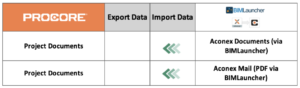
Procore-Aconex integrationA recently launched integration between the Aconex and Procore, for example, focused on two areas of the Aconex platform: its document register and its Mail project communications tool, creating a project-level connection that, when deployed, recreated Aconex data in a structured folder system in the Procore Documents tool. “This helps projects where, for example, Aconex has been used by a design team, but where the contractor site teams are Procore users. Documents approved for construction are pulled across.” The Aconex integration can be run in continuous sync mode or be used for a one-time migration between the systems,  and is now available via the Procore App Marketplace.

BIMLauncher participated in a November 2019 BuildingSmart International OpenCDE-API hackathon involving developers from firms involved in the DIN SPEC 91391 project (see Egan’s December 2019 blog post), and the group (also involved in development of the BuildingSMART BIM Collaboration Format, BCF) is now working on an official BuildingSMART project.

(CDE API Version 1 from buildingSMART International on Vimeo.)

BIM CDE integration

While there is clearly an appetite from some vendors to build better integrations, it’s challenging both technologically – some vendors’ solutions have been in incremental development for over 20 years – and commercially – some vendors may not want to make it easy for customers to migrate projects and data to other providers. However, BIM is providing new opportunities to standardise, and to become more connected. Egan is not enthusiastic about API-based approaches, feels that a ‘hub connector’ enabling integration across multiple CDEs should be the way forward, and talked about the secure use of ‘linked data’ to provide better data visibility across platforms while also maintaining the integrity of that data in its originally hosted platform.

“There is no obvious solution. But the technical challenges for vendors themselves to implement a system that can manage information between multiple systems will take significant investment and time to develop. Alternatively, some vendors are choosing to partner with our BIMLauncher integration hub where we manage connections with other CDEs and tools.

“Ultimately, the vendor with the best integration strategy will be the winner. Some vendors are mediocre in their approach; many have no integration strategy at all. But if they are serious about supporting their clients’ information needs they need to be serious about integration.”

[* Disclosure: I am a member of the UK BIM Alliance executive team and chair of its Technology Group, which includes several vendors of ‘CDE’ technologies. The views are mine alone.]

The post Open CDEs and BIMLauncher appeared first on Extranet Evolution.


Procore IPO in for prolonged coronavirus lockdown?

$
0
0

US construction collaboration SaaS technology provider Procore planned to offer its shares on the New York Stock Exchange in the near future, but its plans could be undermined by the coronavirus pandemic.

Procore logoOn 28 February 2020, California, US-based construction collaboration SaaS technology provider Procore filed registration documents with the US Securities and Exchange Commission relating to a proposed initial public (IPO) offering of its common stock (news release). The company said the number of shares to be offered and the price range for the proposed offering had not yet been determined. It intended to list its common stock on The New York Stock Exchange under the ticker symbol “PCOR.” The IPO could value the company, according to Bloomberg News, at US$4 billion.

The IPO filing gives a lot of background about Procore’s finances. In 2019, revenues were US$289.2 million, up from US$186.4 million in 2018 and US$112.3 million in 2017; the company recorded net losses for all three years: US$55.5 million in 2017; US$56.7 million in 2018; and US$83.1 million in 2019. At the end of 2019, Procore had around 1.3 million users. Potential investor risks included: a history of losses, potential future decreases in construction spending, failure to compete effectively, and miscalculation of the future market opportunity.

Extranet Evolution analysis

Procore has previously raised over US$250 million through a succession of funding rounds, valuing the business at around $3 billion in December 2018 (post). These investments have helped the firm expand overseas into markets including Australasia (May 2017 post) and the UK and Ireland. It has also cultivated a substantial marketplace of complementary integrations with other solutions, and, despite the mounting losses, has made the occasional acquisition (for example, Honest Buildings in July 2019).

The revenue figures make interesting reading, not least because they enable comparisons with the financial performance of other construction SaaS vendors. For example, Aconex, prior to its December 2017 US$1.2 billion acquisition by Oracle (post), generated revenues of US$127.6m (c. Au$161.2m, £99.3m or €108.3m),  in the year to 30 June 2017 (post), a figure that put it just ahead of Procore’s performance at the time.  But Aconex also made an operating profit (US$11.9m – c. Au$15.0m, c. £9.2m, or €10.1m), and claimed a 5.3m-strong user base – nearly four times bigger than Procore’s current figure.

However, global events in the three weeks since Procore’s announcement may well see it shelving its IPO plans (as might Bentley Systems – post). The unfolding coronavirus pandemic has sent markets plunging and many analysts are forecasting a deep recession. Hardly the right time for an IPO. Moreover, past recessions suggest construction experiences a deeper recession than other industries, and takes longer to bounce back. So, even when things do improve, there may be other sectors that offer earlier gains from an investor point of view.

The pandemic is also  likely to lead to a major slowdown in construction activity and spending (see previous post), with a corresponding impact on software vendors including Procore; its revenue growth may falter, with even bigger losses in 2020. The impacts will, of course, depend on the extent to which Procore’s current and future customers – mainly SMEs to mid-sized contracting firms – are affected by the slowdown and how far, if at all, they are supported by clients, banks and governments during the downturn.

The other investor risks – failure to compete effectively, and miscalculation of the future market opportunity – also need to be considered, particularly from a technology point of view. Building information modelling (BIM) was positioned as one of the steps necessary to modernise construction and help it emerge from the financial crisis of the late 2000s; in the UK and several other developed economies, it is seen as a foundation for digital transformation of the built environment. Procore’s platform, though, currently has little BIM functionality compared to its competitors (it has a BIM viewer). Procore-Aconex integrationAconex, and its acquisitions, invested substantially in BIM and associated model, data and workflow management over several years, as have most of Procore’s other key competitors (eg: Autodesk, Bentley Systems, Trimble). But there has been little demand to date from Procore’s SME to mid-sized contractor customers for BIM functionality – most are still predominantly working with conventional drawings, documents and spreadsheets. Integrations with other solutions such as Aconex may help (post), but if Procore wants to compete directly with rival platforms and support larger contractors and owner-operators, it will have to invest significantly in developing or acquiring stronger BIM object capabilities.

[Disclosure: I have written occasional freelance pieces for Procore’s Jobsite, and have provided consultancy services to Procore’s London office.]

The post Procore IPO in for prolonged coronavirus lockdown? appeared first on Extranet Evolution.

Nathan Doughty’s new Asite era

$
0
0

Asite CEO Nathan Doughty talks to Extranet Evolution about COVID-19, industry mergers and future prospects for the UK-based SaaS technology business.

Asite logo 20122020 started on a tragic note at Asite. On 2 January, the independent London-based Software-as-a-Service construction collaboration technology vendor announced that Tony Ryan, Asite CEO, had died suddenly, aged 48. Chief operating officer, Nathan Doughty, was immediately appointed Ryan’s successor. Extranet Evolution talked to Doughty about his new role and about the prospects for the business he joined in 2002.

Doughty had previously worked with Tom Dengenis (until 2018, CEO of Synchro – acquired by Bentley in June 2018 – and Ryan’s predecessor as CEO of Asite) at the UK arm of Bidcom. He then joined Asite to lead its technology initiatives. He was also involved with BSI, the International Alliance for Interoperability / BuildingSMART, and the Network of Construction Collaboration Technology Providers, championing open BIM.

Taking over from Tony Ryan

Doughty reflected on taking offices in such tragic circumstances.

Tony Ryan (past Asite CEO)“Losing Tony [right] was a major personal blow. He was a close friend to me and to many people in the business, and we worked together for many years. It was also very unexpected, of course, so the Asite team has had a period of introspection and mourning, and we’ve all pulled together. We were very fortunate that Tony left the business in a very healthy position.”

What will be different?

“That’s difficult to say. I am a different type of leader to Tony, but we shared the same vision and goals for the business. My role has always been as a product or technology-led individual, while Tony had a strong sales-led approach. Going forward, I think Asite will be more open, both in communications – both internally with colleagues, and externally with customers, analysts and journalists – and in terms of our technology. I have always been a strong believer in openness at a platform level.”

Asite today

Asite has long been one of the most transparent vendors when it comes to its financial and operational performance. This culture of openness started in the early 2000s when Asite was an AIM-listed company, and continued even after Asite delisted in April 2009. Revenue topped £2m in 2010, when the business also declared its first profit. There was a plateau following the Global Financial Crisis but Asite has since enjoyed consistent double-digit revenue growth, up 10% in 2013, for example, 18% in 2017 and, most recently, 20% in 2019.

Turnover in the year to 30 June 2019 was £9.638m (c. US$12.6m or €11.43m), while operating profits were up 83% to £2.484m (c. US$3.25m or €2.95m), and Doughty was bullish about 200-strong Asite strengthening its global footprint. While still heavily reliant on the UK market, which generates nearly three quarters of Asite’s revenues, the company saw some sharp growth in its APAC and North American regions – despite healthy competition from indigenous competitors.

“We are competing product-wise with Oracle Aconex, Autodesk [BIM 360] and Bentley [ProjectWise], but we don’t have their marketing clout,” reflects Doughty. “However, we have some strong customer relationships at the top end of the market – particularly among owner-operators, large government clients particularly in infrastructure (the Environment Agency, Transport for London), and EPCs such as Laing O’Rourke. And we have some significant relationships in the United States (Goldman Sachs, Berkshire Hathaway Energy and New York City MTA [news]) and are developing similar ones in Australia and Hong Kong.”

Doughty has reorganised the business to give it a stronger regional focus (news), Doughty says. The Asite product is managed via a global shared services organisation, serving four regions: North America, India/MENA, APAC, and the UK and Europe. “We are the market leader in the UK; the European Union is a key target, and we’ve started to grow in Belgium and Holland.” In May 2020, for example, Asite announced a deal with Lantis to support its work on Belgian transport infrastructure.

Pandemic impact

The COVID-19 pandemic has, of course, created some uncertainty about future prospects for the global construction industry. And the sector’s technology providers may suffer a knock-on effect. Doughty says:

Nathan Doughty“We were understandably concerned about the potential impact of the UK lockdown. But, so far, our customers are continuing to build – albeit with some slowdowns – so Asite has been sheltered from it. Internationally, our key customers tend to be active in infrastructure and long-term government work. We expect these sectors to remain active as governments emerge from lockdown.”

There is bound to be an ongoing impact on how we operate sites, health and safety, and social distancing while maintaining the health of our contracting sector (which still operates on thin margins). Going forward, government infrastructure spending will continue and grow. Health will be a major focus. We also support transportation industries which will need to operate differently post-COVID, so demand may grow as we figure whether and how extensively or frequently we travel to work.”

Competitive landscape

The earlier mentions of Autodesk, Oracle Aconex, and Bentley lead to a discussion of the industry appetite for mergers and acquisitions, particularly topical given Bentley’s March 2020 acquisition of another UK SaaS collaboration vendor, GroupBC. Doughty believes:

“The GroupBC acquisition is a good buy for Bentley. The rationale makes sense. Bentley needs a stronger SaaS / cloud presence, as fundamentally their business is about older-school on-premise software. Equally, they are strong in design, and less so in construction and asset life cycle, so GroupBC will help them there and especially in the UK market.”

[Doughty was speaking to EE prior to the recent expansion of Bentley’s ProjectWise365 offering – read May 2020’s Coping with COVID-19 using Bentley ProjectWise 365.] He continued:

“We are in an interesting situation regarding serial acquisitions. As well as Bentley’s move, Oracle acquired Aconex, Trimble moved on eBuilder and then Viewpoint, InEight took out TeamBinder, and Autodesk bought Plangrid. They are all focused on a similar space to Asite, but all of these deals have created a lot of opportunity for us. We are talking to customers who find such large-scale organisations are less able to react, less responsive. Where customers want flexibility, I think we have lots of room to grow, particularly in APAC and the US.”

M&A appetite

Has Asite been approached about possible deals? Doughty says:

“We’ve regularly talked to everyone. We’ve had many approaches and spoken to most of the players in the space, and some talks got quite advanced. My view and that of Robert [chairman and majority shareholder Robert Tchenguiz,] is that we can build this business and compete with those guys. Our chosen strategy is to go to the capital markets to fund a sales and marketing-led growth strategy. We see a lot more future value in the business. Our focus is on organic growth, but we also want to build through mergers or acquisition. We are looking at buying businesses to help Asite grow into regions and build its market share.”

Having spent some time growing Asite’s business in North America, Doughty also talked about US-based Procore (which launched into Australasia in 2017 and is now active in the UK market).

“It’s an interesting, newer business, and has been very successful with mid-market regional builders and contractors. However, its product has less depth, little BIM, and little penetration at the top of the market or outside the US. It’s following a very different model to us in its fund-raising strategy and its recent IPO announcement. Our model has been based on slower sustainable growth and delivering profits which are reinvested in product, focused on more secure clients with longer-term infrastructure interests.”

Asite product strategy

Asite cBIM_Model CompareAsite has been among the AEC SaaS pioneers embracing building information modelling (BIM). Doughty’s work at Asite on BIM dates back to around 2006 (Asite BIM, March 2007), and it has benefitted from the UK’s world-leading position in this field, but he sees the future as about digital engineering and building new capabilities in areas such as offsite construction. “With MMC [Modern Methods of Construction], we are very fortunate to have Laing O’Rourke as a customer at the forefront of offsite construction. We’ve been exposed to it, and are taking the manufacturing approach and bringing it into our approach. I am also seeing similar strategies in the Middle East too.”

Where will he be investing in the Asite product set?

“To me, it’s about openness and interoperability. When I was the Asite CTO, our idea was for Asite to be the ‘service bus’ for the industry. We talked about developing open connectors for BIM, for electronic data interchange, for real-time data from asset sensors. Today, our strategy is about digital engineering; about providing a common data environment during project delivery, and then being able to connect to operating environments for asset management to help the world build better.”

The post Nathan Doughty’s new Asite era appeared first on Extranet Evolution.

Growth continues at Asite

$
0
0

SaaS construction collaboration technology provider Asite grew its revenues and profits in the year to 30 June 2018. With AEC acquisitions happening almost monthly, is the London-based vendor the next big target?

Asite logo 2012According to its just-published annual report (here), the London, UK-headquartered company saw revenues grow 12% from 2017 to £8,004,773 – around US$10.47m or €9.17m. During the same period, operating profit increased 85% to £1,357,702 – around US$1.78m or €1.56m – from 2017’s £733,370.

The revenue growth figure represents a slight slow-down on the 2016-17 year, which saw revenues climb 18%, while the operating profits showed a bounce-back after dipping in 2017 for the first time since the global financial crisis.

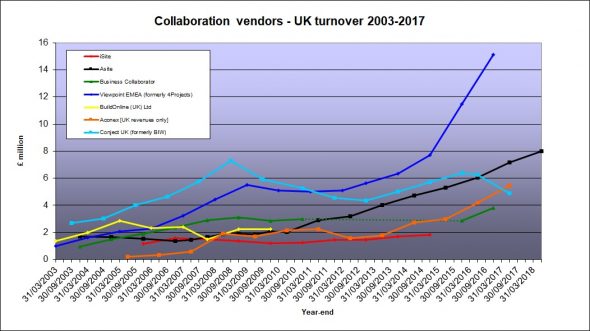
construction collaboration vendor revenues to June 2018

This latest report was published less than five months after Asite’s previous results announcement, when it highlighted its investment in new offices in Hong Kong and development of its New Dawn release of Adoddle, launched in March 2018. Tony Ryan (Asite CEO)CEO Tony Ryan’s messages still focus on its growing global footprint and new releases of its Adoodle platform (the latest wheeze has been an instant messaging tool, aMessage); he describes the company’s common data environment as providing “Common Data Everywhere” (another variant on CDE – Bentley Systems has, for example, been talking about its “Connected Data Environment” for some years; post).

Global footprint

Within its “global footprint”, the mature UK market still contributes the largest proportion of Asite’s revenues: 76.9% – up slightly on 2017’s figure; revenues grew by 12%. Revenues were up in every other region apart from the Middle East, for which no figure was supplied (any revenues from that region were presumably rolled into results elsewhere – perhaps with India, where revenues jumped 60%). Elsewhere, revenues were up nearly 31% in Australasia, and 11% in Europe, while revenues grew by a comparatively sluggish 6.5% in north America – dropping it to third place in revenue terms behind the UK and Australasia.

Headcount dropped over the 12 months to June 2018, from 242 to 213 – the bulk of the reductions being born by Asite’s largely India-based technical team which shrank from 205 to 183 people. Excluding directors’ remuneration (some £614,000), the total wages and salaries bill was around £2.6m, meaning the average pay for an Asite employee is just over £12,000 – underlining the low cost-base provided by Asite’s Indian operation.

The next big deal?

Asite is in an interesting position compared to its competitors, particularly those from the UK. Following the acquisitions of BIW by Conject (then Aconex, then Oracle; post), and of 4Projects by Viewpoint (then Trimble; post), Asite is now – in revenue terms – the largest UK-based independent construction collaboration vendor. It must surely be being courted by potential acquirers (perhaps the rapid publication of its latest results and the trumpeting of its 85% profit growth is partly a marketing ploy to would-be suitors? See: the next big AEC SaaS acquisition?)

The UK market is also targeted by other US-based vendors – not just old hands like Autodesk (first Buzzsaw, now BIM 360 Docs) and Bentley (ProjectWise), but more recent arrivals such as Plangrid and Procore. The leading German players RIB and think project! might yet also enter the UK collaboration market – the latter acquired the UK’s CEMAR in May 2018 – while Belgium’s Bricsys 24/7 could be boosted following its recent acquisition by Hexagon (post).

The post Growth continues at Asite appeared first on Extranet Evolution.

Construction-savvy Plangrid adds to Autodesk toolset

$
0
0

Plangrid has been expanding into the UK since 2017 with internationalisation now largely complete, and the solution now more about workflows than ‘sheet’ management. Company executive Bill Smith also identified how Plangrid complemented Autodesk’s design strengths.

Plangrid logoOn 18 October 2018, around a month before Autodesk announced its US$875m acquisition of Plangrid, I talked to Bill Smith, Plangrid‘s president of global field operations, about the company’s growth.

Smith was in London to visit the Digital Construction Week trade show, and to work with Plangrid’s growing UK-based team, now 10-strong, as it expanded its sales and marketing efforts (having made its first concerted UK marketing efforts with a stand at DCW in 2017).

Internationalising Plangrid

The company has since recruited UK staff from other vendors, including three people from Viewpoint, he said. Viewpoint has apparently been shedding some UK staff following its April 2018 acquisition by Trimble, while Plangrid said it had also attracted interest from some Viewpoint customers when it exhibited recently at UK Construction Week in Birmingham.

As well as Viewpoint, Plangrid’s competitive landscape includes mature SaaS solutions such as Oracle Aconex, Asite, Procore, Autodesk and Bentley’s collaborative toolsets, plus more recently founded businesses such as US rival FieldLens and France-based Finalcad – which Smith said shared some investors with Plangrid, and was encountered as a rival for projects, particularly in Asia. Plangrid was also getting enquiries from potential customers in mainland Europe, he said – the UK was to be the hub of the company’s European operations.

Since 2017, Plangrid had spent time internationalising its solution so that it would appeal to non-US construction businesses, with the work likely to finish in early 2019, Smith said:

“While most of the functions are the same – they are just called different things, so we have either renamed processes or given them more generic titles. … Plangrid started out working on US hospital projects so we learned from how teams worked on those, but even in the US there are different terms for the same things. Most of the internationalisation, particularly in the back end, is now complete, so it’s now about rethinking US names such as punchlists to make them more generic – we are tending to talk more about ‘issues’ and ‘tasks’ now, for example.”

Plangrid Android drawing viewThe platform has expanded from its original focus on ‘Sheets’, and moving more towards of a classic SaaS workflow platform, he continued. “We are managing submittals, issues, tasks – we’ve just done a major release on this – and we are now more of a business application rather than managing paper.” Building information modelling (BIM) hasn’t had a major impact yet, but Plangrid was planning a new release incorporating a 3D viewer in early 2019.

The Plangrid platform is hosted by Amazon Web Services (AWS), with UK customers currently supported by an AWS facility hosted on the US east coast – though, as a mobile solution provider, Smith said customers should be less concerned about “data at rest” and focus on ensuring device and transmission security. “Construction is probably the least secure industry I’ve every seen in my life.”

Initially iOS-only, the Plangrid solution is now available on Android and as a Windows application, as well as offering a web browser-based environment, with major releases made about every 60 days. People in management tend to like iPad devices, but at site level smartphones are more widely deployed, Smith said. Originally developed in English and Spanish language versions, the solution is now supported in approaching 20 different languages.

Plangrid growth

By October 2018, Plangrid’s global headcount had grown to 380 staff, and the company was planning to reach 400 by the end of 2018. Most of these staff are based in the United States, with around a third in San Francisco. International sales and marketing offices in Canada, the UK, Australia, Hong Kong and India (and “soon to be in Singapore”) accounted for around 40 people, he said.

Bill Smith - Plangrid president, global opsGlobally Plangrid has around 10,000 paying customers (“we’ve moved from the original user model to a customer model”), predominantly in its US heartland, but including a growing number (“currently around 200 customers”) in each of EMEA and Asia Pacific. This translated into around 100,000 end users of the Plangrid platform, with user growth currently around 15-17% year on year, and the company is “acquiring about 10 customers every day”. Smith said Plangrid was seeing growing interest from owner-operators (he divided the company’s customer base into roughly 20% owners, 40% general contractors and 40% subcontractors) – with hospitals, retail, hotels, and corporate campus owners increasingly interested in the platform.

Smith joined Plangrid in October 2014, shortly before its US$19m Series A funding round, led by Sequoia Capital, in May 2015. The company then had about 45 employees, and Smith’s job was to grow the Software-as-a-Service business, drawing on over a decade’s experience of successfully growing SaaS operations at San Francisco-based Taleo, a HR solution acquired by Oracle in 2012.

A Series B Funding round in November 2015, led by Tenaya Capital, with additional fundings from Sequoia Capital, Founders Fund, Y Combinator, and Northgate Capital, raised a further US$40m (news) – a round that valued the company then at US$419 million, according to PitchBook. Ambitions were to grow the company in what was seen as a massive market that is just beginning to utilise technology in the field, with a view, Smith said, to future acquisition or a possible float – though he said compliance issues often deterred US businesses from going public. He had identified a lot of interest in construction from software majors including SAP and Microsoft, and mentioned that former Autodesk CEO Carol Bartz now sits on Plangrid’s board. Regarding Autodesk’s solutions he said, “We overlap a little bit on design, but mainly we pick up where they leave off as teams move into construction.”

Postscript

That final remark perhaps confirms some of the rationale for Autodesk’s acquisition. Its mobile solution is attractive to workers needing information out on site – not an area where Autodesk solutions have traditionally been strong (to be fair, this is also common to other software vendors strong on design – rival Bentley Systems, for example, has been growing out its construction management toolset too; post).

The business is also growing at a good rate, expanding into new markets, taking the collaboration battle to rival products such as Viewpoint and Aconex – both going through post-acquisition adjustments – and offers a strong mobile-first product to complement Autodesk solutions that were mainly designed for office-based deskop/laptop interaction.

The post Construction-savvy Plangrid adds to Autodesk toolset appeared first on Extranet Evolution.

BIMtech provider Opentree acquired by Graitec

$
0
0

UK-based document and BIM process management software developer Opentree has been acquired by Graitec.

Opentree logoTeesside, UK-based Opentree, a provider of enterprise document management solutions, has been acquired – for an undisclosed amount – by France-based Graitec, an Autodesk reseller and developer of BIM, fabrication and design software (it has a UK office in Southampton). Opentree’s software portfolio includes a PAS 1192-compliant BIM workflow solution, Cabinet (May 2017 post), widely integrated with several providers of common data environments (CDEs), including Oracle Aconex, Business Collaborator, Viewpoint (October 2017 post) and Autodesk’s BIM360 Docs.

Cabinet logoCabinet supports the in-house “work-in-progress” phase of BIM authoring, prior to designs being shared with the client’s wider project team. UK BIM expert Mervyn Richards worked with the firm to ensure it supports the BS1192:2007 processes required at Level 2, with Cabinet helping compliance through automated file naming and seamless upload to the client’s CDE.

Practices and businesses with a further requirement to publish project data externally to a hosted environment are then often faced with the challenge of interfacing with  multiple CDE vendors. Opentree’s Cabinet enables firms to manage internal documentation and model information locally throughout the project lifecycle and then publish to CDEs of their – or the principal contractors’ – choice, as and when a particular project dictates. A Software-as-a-Service version of Cabinet has been in development and this will continue.

Along with engineering client businesses such as Sellafield and TSP Engineering, UK AEC customers include UK contractor NM Group, offsite construction specialist Fusion Building Systems, and the Purcell design practice.

Graitec view

In the company’s announcement, Graitec president Francis Guillemard says:

Graitec logo“this acquisition will be pivotal in helping our customers with the day to day management of their project documentation from initial conception and tender, through to project delivery.”

Steve Houlder, Graitec COO says:

“The BIM market and the BIM for Manufacturing market is growing at a rapid rate in many countries. One of the major difficulties faced by our customers at all levels from housing development through to capital projects, is the management of data from project conception to the start of the collaboration phase, ensuring data consistency and adherence to standards being one of the most important topics. With Opentree we can address this growing issue for many of our customers, aligning Graitec and Autodesk technologies.”

 In September 2018, Graitec launched its BIMUP programme, offering customers tailored implementation and training support in deploying BIM. Opentree’s Cabinet would seem to be a strong addition to this offering.

Opentree view

Opentree MD Andrew Frank says:

Andrew Frank“By joining Opentree and Graitec, our customers will further benefit from being owned by a company with a long history in design and collaboration, who have the skills and expertise to push Opentree even further into the market of W.I.P. management, We see this a key strategy for all customers to manage this process better than they do today.”


Graitec says it will now offer data management and W.I.P. management to customers who have been trying to solve the problem. By helping them adhere to data standards, deliver consistency, conform to both BS1192 and the upcoming ISO19650 BIM standards, Graitec claims it will be at the forefront in helping customers manage their data and projects effectively enabling them to achieve  time and cost savings, as well as improving internal and external data quality processes.

[Disclosure: Opentree has been a client of pwcom.co.uk Limited since July 2017. This post is not part of its work for the company.]

The post BIMtech provider Opentree acquired by Graitec appeared first on Extranet Evolution.

Autodesk buys BuildingConnected

$
0
0

Autodesk’s December 2018 acquisition of the BuildingConnected bid management platform for US $275m embeds Autodesk in the US pre-construction sector.

BuildingConnected LogoOn 20 December 2018, just over a month after announcing it was acquiring US-based SaaS construction management developer Plangrid, Autodesk announced it was also acquiring another US company: BuildingConnected, for US$275m. This San Francisco-based company specialises in pre-construction processes including bid management and risk analysis, and Autodesk believes its network of over 700,000 construction professionals presents an opportunity to create a robust digital marketplace for construction goods and services.

BuildingConnect WorldFounded in 2012, BuildingConnected helps real estate owners and general contractors find and hire qualified contractors for their projects, and claims to be the largest and most active digital network of construction professionals, though the vast majority of its users are based in the United States. Customers include Turner Construction, McCarthy, Mortenson, StructureTone, Skanska, Clark Construction, Ryan Companies and AECOM.

BuildingConnected CEO and co-founder Dustin DeVan said:

“Bid management is a critical step in preconstruction, since bidding is the genesis of construction projects. Our game-changing suite of preconstruction tools are saving customers time and money. We’ve helped thousands of owners, general contractors and subcontractors streamline their businesses and communicate better. Together with Autodesk, we can expand the platform’s capabilities and scale globally.”

Autodesk CEO Andrew Anagnost said:

autodesk logo“We are investing in digitizing and automating construction workflows. Autodesk’s goal is to connect construction processes across design, build and operations. BuildingConnected has proven to customers the tremendous value in moving from traditional rolodexes, whiteboards, emails and spreadsheets to an easy-to-use digital bidding platform. BuildingConnected, along with Autodesk BIM 360, Revit, AutoCAD, and our acquisitions of PlanGrid and Assemble Systems, gives us a comprehensive construction offering and go-to-market capabilities. We look forward to integrating our recent acquisitions and making construction Autodesk’s next billion-dollar business.”

Jim Lynch, Vice President and General Manager, Autodesk Construction Solutions said:

“This acquisition provides an opportunity for Autodesk and BuildingConnected to connect every business in the construction industry, becoming the definitive source of information throughout the sector. Our tools empower all stakeholders with greater visibility and better information to make immediate decisions. We’re excited about creating a robust digital marketplace for the global construction industry, helping to boost productivity, while lowering cost and risk.”

In addition to its BC Pro bid-management platform, BuildingConnected offers TradeTapp, a subcontractor risk analysis platform, and Bid Board Pro, a platform that helps subcontractors manage bids.

The Extranet Evolution view

The deal will strengthen Autodesk’s position as a service provider in the north American contracting and subcontracting market, but – if it intends to do so – extending this capability to new markets will be challenging. Different countries have different approaches to procurement, and the process of bidding – or tendering – for contracts is generally quite complex, sometimes highly regulated, and has proved slow to change.

In the UK construction industry, for example, e-tendering has been offered by various vendors since the early 2000s. I was at SaaS collaboration vendor BIW Technologies (today part of Oracle Aconex) when it launched a tendering option, and UK rivals, including 4Projects (today part of Trimble’s Viewpoint business), Asite and now-defunct BuildOnline, were soon doing the same. The Royal Institution of Chartered Surveyors published guidance on the area and, in 2007, jumped into the marketplace too, with RICSeTendering.com, and there were other stand-alone tendering solutions too, but use of online e-tendering tools long remained a minority pursuit – most tenders were still sent and returned by post or email.

In Australia, e-tendering was also something developed by Aconex (initially through its Bidcontender service) and by regional competitors such as EstimateOne (July 2014 post).

Bentley logo 2017And BuildingConnected is not the only player in the US market. In October 2017, Bentley Systems announced it was acquiring eBid Systems, developer of the ProcureWare solution. Bentley claimed eBid Systems provided procurement solutions to “hundreds” of organisations, collectively managing over 270,000 vendor accounts.

Scaling BuildingConnected to become a global platform for bid management will involve extensive internationalisation of the solution to suit different legal, financial and industry prequalification and procurement regimes, as well as multiple language support. So far as the core solution is concerned, this Autodesk deal looks likely only to have an impact in the US, at least in the short-to-medium term.

The post Autodesk buys BuildingConnected appeared first on Extranet Evolution.

Construction Technology Report 2019: the designers’ view

$
0
0

A recently published ‘Construction Technology Report’ from Newcastle-based NBS presents a view of digital adoption, but is flawed by its narrow focus on building design businesses.

In May 2018, the 2018 (8th) annual BIM survey from NBS presented some data on adoption of common data environment (CDE) platforms by UK-based construction businesses. The data suggested a wide continuum: from 21% of firms using a CDE for all projects, to 28% not using any CDE at all.

Survey responses suggested that Viewpoint’s platform (now part of Trimble’s portfolio) was the most widely used, but I had reservations about how representative the sample was. It over-represented architects (hardly surprising, perhaps, given NBS’s RIBA Enterprises history), and swayed towards building design. This mean those working on the UK’s civil engineering infrastructure (highways, rail, utilities, etc) were under-represented. I felt it potentially downplayed the adoption of tools such as Bentley ProjectWise and GroupBC’s CDE, and overplayed the adoption of generic file-sharing applications such as DropBox, Microsoft’s Sharepoint and Google Drive.

Construction Technology Report 2019

NBS Construction Technology Report 2019For the first time, NBS has undertaken a separate survey looking at the technologies. Recently published, the NBS Construction Technology Report 2019 (available here) is based on quantitative research undertaken in late 2018 to which over 500 people contributed. Little further information about the sample is given though a question (p.13) about internal collaboration is broken down into just two groups: architectural practices and multi-disciplinary practices. Unfortunately, this suggests the survey did not extend to, say, non-architecture design firms, contractors, specialist subcontractors, project managers, manufacturers, clients, etc. Again, NBS results therefore reflect the views of a relatively narrow and building-focused segment of the construction industry.
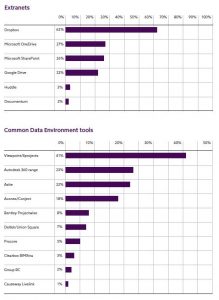
The sample appears largely positive about the benefits of ‘digitisation’, recognising that a failure to adopt digital technologies could put companies out of business, and accepting that construction lags other sectors in its digital technology adoption (p.11). Clear majorities believed that both internal and external collaboration had changed as a result of technology adoption. Design activities still involve considerable work with documents and spreadsheets (lots of paper on the desk shown on the report’s cover!), referencing standards and specification writing; 2D design (72%)  was still slightly more common than 3D work (67%), but use of ‘project extranets’ or CDEs was only part of the work of 45% of respondents.

The NBS survey then dives deeper into the data for each of these design activities. Perhaps not surprisingly, its sample are prominent users of NBS for specification writing, and the NBS National BIM Library is the most widely used BIM object library (60%), ahead of BIMobject (37%) and BIMstore (36%; post).

NBS Technology Report 2019 graphsThe findings regarding extranets and CDEs were presented in two bar charts. The ‘extranet’ solutions were essentially generic file-sharing platforms: Dropbox (62%), Microsoft’s OneDrive (27%) and Sharepoint (26%), and Google Drive (22%) were all a long way ahead of Huddle and Documentum.

A skewed view of CDE adoption

The most frequently selected construction-specific CDEs came from Viewpoint/4Projects (41%), Autodesk’s 360 range (23%), Asite (22%), Aconex/Conject (18%), and Bentley Projectwise (8%). The high figure for Autodesk may well reflect the popularity of Autodesk design tools among this building-led sample – 69% were users of Autodesk CAD and modelling applications (an industry source told Extranet Evolution: “whilst [360] may be licensed, is it used in anger?”). Similarly, the low figure for Bentley Projectwise follows naturally from the under-representation of infrastructure design in the NBS’s sample.

Next was Deltek/Union Square at 7%. This perhaps further confirms the design-led nature of the sample, as Union Square, acquired by Deltek in 2016, grew largely through adoption by SME design firms of its locally-hosted practice management platform, Workspace, and only gradually extended to ‘extranet’ type functionality as a response to a minority of contractor customers. (A competitor commented: “An internal information management system with drawing register/issuing capabilities doesn’t really constitute a CDE.”)

The NBS’s CDE barchart is completed by Procore (5%) Clearbox’s BIMxtra (3%), GroupBC (2%) and Causeway LiveLink (1%). Heavily backed by investors, US-based Procore has only recently started to market itself in the UK; Clearbox is strongly associated with the UK Tier 1 contractor Kier (post); while GroupBC is another solution extensively used on civil engineering infrastructure projects, and is often ‘white labelled’ by its customers – who include the UK’s biggest contractor Balfour Beatty, fellow Tier 1 players Costain and BAM, retailer Sainbury’s, and Thames Water, among others (see October 2017 post).

Update (9 April 2019) – In a 5 April 2019 blog post by Stephen Hamil, NBS has announced partnerships with some of the companies offering CDEs: “We want to develop a stronger link between the well-structured content within the specification and the tasks that are required by other members of the project team in particular, so they can be tracked in the CDE. … We’re delighted to have announced partnerships with Asite, Autodesk BIM 360, Newforma and Viewpoint.

It’s now about ‘digitalisation’

‘Digitisation’ is the process of converting information into a digital format, and many of the design firm activities described in the NBS Construction Technology Report are clearly in transition from analog practices to being digitally enabled. In his punchy and readable introduction, Stephen Hamil looks to a future where the ‘BIM conversation’ has moved on from a focus solely on the 3D model to “a rich cloud platform of connected technology from multiple providers.” NBS also includes some interesting practice profiles looking at the technology stacks being developed by some design firms. NBS technology offerings such as its cloud-based specification product Chorus (launched in August 2018) are strongly promoted in the document (which ultimately has to be seen for what it is: marketing collateral targeted at NBS’s architecture-led design market).

Digital Built Britain diagramPedantically, perhaps we should be talking more about ‘digitalisation‘: “the use of digital technologies to change a business model and provide new revenue and value-producing opportunities – the process of moving to a digital business” (to use Gartner’s definition). I have been speaking to audiences recently* about how businesses need to do more than just adopt new technologies – they need to take on the challenge posed in “Digital Built Britain” in February 2015 and start thinking about new ways of doing things, new ways of thinking, new business models.

Mark Farmer, author of the October 2016 industry report “Modernise or Die”, spoke at the Irish Embassy in London earlier this week, and was clear about the need for construction businesses to change. If they didn’t, he warned, they could find themselves replaced or bypassed (“be substituted or disintermediated“) by more digitally adept and more integrated organisations. Design businesses like those targeted by NBS will not be immune from these changes – the ongoing shift towards more manufacturing-led approaches to construction will require them to rethink their key business relationships and their supporting processes and information practices.

[* For example, I have been talking at designer-oriented events organised by Specifi; the next of these will be in Leeds on 19 March 2019, followed by Birmingham on 2 April and Nottingham on 30 April.]

The post Construction Technology Report 2019: the designers’ view appeared first on Extranet Evolution.


HammerTech raises Au$10m (US$7.1m)

$
0
0

HammerTech raises Au$10m (US$7.11m) to fund expansion into the US, and accelerate its product development and sales and marketing.

Hammertech logoHammerTech, the Melbourne, Australia-based mobile provider of health, safety and quality software for the construction industry, has announced completion of a Au$10 million (US$7.11m – £5.4m or €6.33m) Series A financing. The funding was led by Santa Monica-based Arrowroot Capital, a leading growth equity firm specialising in B2B software.

The investment will allow HammerTech to accelerate its product roadmap, grow the sales and marketing teams and support continued expansion into the United States. As part of the transaction, Chuck Haling and Matt Klein, from Arrowroot Capital, will be joining the board.

Milton Walters, CEO of HammerTech, said:

Milton Walters“It’s an exciting time for HammerTech and we are thrilled to have gained support and investment from Arrowroot. Within five years of being founded, we’ve worked tirelessly to introduce an advanced software platform to construction that empowers operational excellence. With Arrowroot’s experience and partnership we’re looking forward to enhancing our product capabilities, growing our global footprint, and increasing collaboration on job sites.”

Matthew Safaii, Arrowroot Capital’s Founder and Managing Partner said:

“HammerTech has positioned itself to be the go-to health, safety and quality software for the construction industry. Their mobile-first platform drives operation efficiencies, keeps workers safer and improves quality across all aspects of the construction process. We are excited to partner with the HammerTech team to help scale their platform around the globe.”

HammerTech: the company

HammerTech homepageBased in the Melbourne district of Richmond, Australia’s SaaS technology provider HammerTech has been attracting interest from several major international contractors, and – in its first major foray outside Australia – has opened US offices in Los Angeles and Seattle. Extranet Evolution talked to CEO Milton Walters about the company, its platform philosophy and its growth plans.

HammerTech’s subscription-based platform is available on all devices and is designed to meet the demands of companies seeking to better manage their operations and HSEQ obligations. HammerTech customers typically see results in valuable time saved and increased safety and quality measures.

Milton Walters

Milton Walters is an Australian construction software industry veteran. After entering the sector in 2006 at Aconex, he has worked with other leading ConTech players including Textura and Procore during the last 12 years.

These experiences have left Walters with an abiding respect for some of the people he has dealt with – he talks with affection about Aconex’s Leigh Jasper and Rob Phillpot, Textura Europe’s Colin Smith (now chairman of Newcastle, UK-based NBS), and Procore’s  Bassem Hamdy, for example. “Thanks to these fabulous people, I have had a ten-plus-year preparation in construction technology for the role I am in now. They really helped shape my thinking.”

HammerTech history

HammerTech was established in about 2013 by a close-knit group of five friends: Ben Leach, Lucas McDonald, Bradley Tabone, James Harris and Andrew Hogben. Two had Australian construction industry experience (Leach was at Baulderstone and APP, working on facilities for the Australian Grand Prix; McDonald was also at APP and at Westpac). Two came from the tech sector as product developers (Tabone was at National Australia Bank; he and now CTO Harris also both worked at ExpressIV online), while Hogben, having just sold a recruitment business, was the “fifth Beatle” providing some finance and sales experience.

Hammertech screengrabAs with some other construction technology founders, frustration with over-reliance on Excel spreadsheets to manage safety and quality inspired the development of the SaaS-based HammerTech platform. “It’s been developed for safety by people within safety,” said Walters, “it’s not been developed as a spin-off of document management, for example. We don’t start with forms – our starting point is how do we increase operational efficiency and reduce risk, which ensures the correct focus.”

With APP’s Australian GP as the first client project, the business was initially funded by its founders, family and friends, and by one ‘angel’ investor. To date it has required no significant additional investment, says Walters, though it did secure a AU$700,000 Australian federal government accelerator grant in late 2017. Partly as a consequence of this grant, Walters joined the company in April 2018 (“so far it’s been the most enjoyable 12 months I’ve had in my career”). He says HammerTech now employs around 30 people, but, with the new funding, was planning to grow to around 60 people by the end of 2019. Growth to date had largely been sustained by generated revenues, not by investments or funding rounds.

HammerTech started 2018 with around 35 key accounts, but has since grown to around 100 commercial customers (“and we may double again this year”). As well as APP, early successes included adoption by Australia’s LendLease, Mirvac, and one of the country’s oldest Tier One contracting firms, Hutchinson, contracted with the company in late 2018, Walters said. He also related how the company’s focus on delivering its promised functionality has helped build customer trust.

US expansion

“HammerTech expanded into the US in 2017 after receiving some enquiries in response to a LinkedIn post. Brad Tabone and Andy Hogben went over to the US, and we soon had some trial accounts. Then a Top 10 – and innovative – general contractor, DPR, signed a national agreement with us in America in December 2018, and that’s been a massive shot in the arm for us. We will be on 700 DPR projects in about 12 months, now have half a dozen people based in the US,  and are recruiting aggressively in the first half of 2019 as the business expands.”

Walters also highlighted a billion dollar project for LendLease in Los Angeles, Oceanwide Plaza, as another major endorsement: “At LendLease’s safety summit in New Jersey we had safety supervisors rapt at what we were doing”. And adoption by major international contracting corporations could also see HammerTech expand into the UK and into southeast Asia, he says.

In the past year, HammerTech has increased its foothold in the Australia and North America markets and has doubled its client base. It now has tens of thousands of users on the platform and is being used on billions of dollars worth of construction projects globally.

Former Procore director of demand generation Chere Lucett joined HammerTech in 2018 and says:

Chere Lucett“We are responding to growing regulatory requirements. Operational safety is going to be the next frontier in the US construction technology market. The industry lags behind manufacturing, but you can’t improve project management efficiency without also improving safety and quality, and we are well placed to manage that data.”


Echoing Walters’ earlier point about focusing on operations rather than paperwork, she says the HammerTech platform has been designed to track personnel, equipment and issues, providing a centralised safety and quality dashboard, helping with online orientations, developing safety plans and then supporting proactive risk management. The solution provides 16 integrated modules that make it possible to have everything in one place, allowing customers to replace paper, Excel, and individual apps.

Update (29 November 2019) – Milton Walters stepped down as CEO in October 2019, with one of the co-founders, Ben Leach, taking his place. (I understand Milton’s wife died in July after a long illness, and he is currently ‘taking some time out’.)

The post HammerTech raises Au$10m (US$7.1m) appeared first on Extranet Evolution.

Envision: building construction transparency

$
0
0

Envision is winning new infrastructure customers, and its data-centric approach fits with data-driven visions of the future of the industry currently known as construction.

Envision logoEnvision is expanding its reach into civil engineering projects, and even reaching outside its Australasian heartland. The Brisbane, Australia-based field construction data platform is now being used extensively on road, rail and tunnel projects, says co-founder and head of engineering Adrian Smith, while Australian customers have taken the technology to their projects in places including Papua New Guinea and even Mongolia.

Launched in 2010 (see May 2011 post), Envision set out to simplify construction management, adopting a mobile-first Software-as-a-Service approach, integrating mobile devices with 3D, scheduling and time management tools, and applying lean thinking. The Australian engineering and infrastructure contractor Downer Group was an early adopter, and the former Leighton group, CIMIC, soon followed (see January 2016 post), using Envision on major liquid natural gas facilities and other natural resources projects.

However, the business has also won enterprise customers involved in a string of major road and rail infrastructure projects, particularly in eastern Australia, Smith said, and has been marketing itself as a field-based construction delivery platform, connecting project leaders with real-time insights and providing “unparalleled visibility of project performance”:

“Envision was used by CPB Contractors to help deliver Stage 2 of the Gold Coast light rail project, a vital part of the infrastructure for the 2018 Commonwealth Games, and helped reassure the client on progress and cost projections. It is being used on a four-year, Au$400m project to add a second runway at Brisbane Airport, and on the Sydney and Melbourne Metro projects. And in Papua New Guinea, Clough is deploying Envision on a power station at Port Moresby – field data can be quickly gathered on site, and relayed back to Clough’s experts in earned value management (EVM), saving costly manpower resources.”

In an Envision case study about Port Moresby power station, Clough operations manager Geoff Scott says: “The technology allows us to run with leaner project teams. We now have improved quality and frequency of communications.”

Envision: data not document management

Envision marketing chief Kirk Kulbe, formerly at design giants Bentley, Intergraph and Autodesk (on left in photo below, with Adrian Smith) underlined that the platform is not about document management:

Envision's Kirk Kulbe and Adrian Smith

“The core strength of platforms such as Aconex is document management, or latterly building information modelling, BIM, and related communications. We don’t compete with systems like Aconex and ProCore – we complement them. We are all about the data, giving a clear line of sight on what is happening in the field, so that teams have real-time or next day reports on whether the project is on course in terms of progress and cost. Envision captures data close to the user, in place, in time, and about the people doing the work. This kind of operational data is distinct from that captured in building information models.”

However, Envision can also be used to track design progress. The Melbourne Metro project had been using Envision to track the progress of design, and the associated earned value of design deliverables, Smith said.

Having  recently written an Envision blog post – “The ‘good oil’ on construction data” – Smith expanded on the theme, saying Envision is more about project controls.

“Design information is great when you are visualising what will be constructed, but once you are working on a live project, you also need a dashboard showing live information about how construction is progressing. Too often, tools like [Hexagon’s] Ecosys or [ARES’s] Prism are used to collate end-of-month data. We provide data immediately or, at the latest, next day – showing exactly what was achieved yesterday. We record both physical progress and labour, plant and material resource quantities and costs; so we can calculate daily progress and daily cost, and use EVM to show the daily value achieved.”

Envision construction dataBy capturing and centralising data in a consistent way, Envision “de-risks” projects, avoiding common problems arising from over-reliance on spreadsheets, with different professionals compiling different data in different ways. In his blog post, Smith highlights research showing that over 90% of spreadsheets contained errors and 23% contained serious errors. Being data-driven avoids reliance on anecdotes or gut feel; objectively gathered data provides a sounder basis for decision-making, he says.

Productivity and transparency

Compared to other industries, productivity in construction across most developed economies has effectively flat-lined for the past 25 years, hampered by an often-adversarial culture, disjointed procurement processes, fragmented project team and industry structures, low levels of investment in technology and R&D, and other issues. Mark Farmer’s 2016 report on the UK construction sector, “Modernise or Die”, highlights these and other symptoms of a broken industry model, and the Australian market shares many of the same challenges.

Smith feels data-driven decision-making can be used to help alleviate some of these issues: “The name Envision suggests transparency,” he says, “and by providing a consistent dashboard to all stakeholders, you can help to create a more collaborative culture.”

The Farmer Report provided additional momentum to ongoing efforts to improve UK construction, as I wrote in August 2018 (Don’t just digitise. Rethink construction). Short-term adversarial business models are being rejected in favour of longer-term business relationships founded on collaborative processes and behaviours; government is shifting from lowest price tendering to demanding best whole life value; and, rather than seeking bespoke project solutions, industry clients are looking at greater standardisation and increased use of offsite manufacturing techniques.

Digital Built Britain diagramIn July 2018, the Construction Leadership Council published its “Procuring for Value” report, advocating procurement based on delivery of best whole-life value and performance, with a strong focus on measuring and rewarding good asset and supplier performance. Related initiatives such as Digital Built Britain and the ICE’s Project 13 also urge digital transformation of the industry currently known as construction, and some of the UK industry’s largest customers are increasingly looking for suppliers who can work digitally. The industry has to move beyond document and file-based thinking and make data the new normal, but it will not just be about digital thinking – it will be about rethinking construction as a whole.

Data-centric project delivery practices, such as those encouraged by Envision, have to form part of the future of the sector. Smith has set out some guiding principles for improving data maturity, including:

  • Capture [data] electronically close in person, place and time
  • Align how the project performance is to be measured with the financial system
  • Use reference codes/identifiers/geolocation for resources (people, equipment, materials, companies) to allow easy cross-referencing
  • Express data in self-describing formats where possible
  • Exchange data in neutral file formats – avoid proprietary file formats
  • Agree a “source of truth” for core data like budgets, people, equipment, …
  • Convert data into information and drive decision making.

The post Envision: building construction transparency appeared first on Extranet Evolution.

Oracle launches Aconex Model Coordination

$
0
0

Oracle has launched a new BIM coordination tool to expand its Aconex platform, now being assimilated into the Oracle portfolio

Oracle Aconex 'logo'It is just over a year since Oracle‘s 2017 US$1.2bn acquisition of the Australian Software-as-a-Service collaboration vendor Aconex was approved by shareholders, and since then the US giant has been relatively quiet about its new business/product (now branded as an Oracle Construction and Engineering product offering, alongside Primavera and Textura, acquired in 2016 – post). Recently, however, it launched a new building information modelling (BIM) coordination capability: the Oracle Aconex Model Coordination Cloud Service.

Oracle says (news release) this will help resolve common BIM issues – a lack of collaboration, reliance on multiple applications, and missing integrations – by enabling construction design and project professionals to collaboratively manage BIM models across the entire project team in a true common data environment (CDE). As such, organisations can reduce the risk of errors and accelerate project success by ensuring each team member has access to accurate, up-to-date models.

“Issues with model management means projects go over budget, run over schedule, and end up with a higher total cost of ownership for the client. As part of the early access program for Oracle Aconex Model Coordination, it was great to experience how Oracle has solved these challenges,” said Davide Gatti, digital manager, Multiplex.

Single source of truth

With Oracle Aconex Model Coordination, organisations can eliminate the need for various point solutions in favor of project-wide BIM participation that drives productivity with faster processes and cycle times, enables a single source of truth for project information, and delivers a fully connected data set at handover for asset operation.

The Model Coordination solution enhances Oracle Aconex’s existing CDE capabilities, which are built around Open BIM standards (IFC 4 and BCF 2.1) and leverage a cloud-based, full model server to enable efficient, secure, and comprehensive model management at all stages of the project lifecycle.

The Oracle Aconex CDE, which is based on ISO 19650 and DIN SPEC 91391 definitions, provides industry-leading neutrality, security, and data interoperability. By enabling model management in this environment, Oracle Aconex unlocks new levels of visibility, coordination, and productivity across people and processes, including enabling comprehensive model-based issue and clash management.

Key features of the new solution include:

  • Seamless clash and design issue management and resolution
  • Dashboard overview and reporting
  • Creation of viewpoints – e.g. personal “bookmarks” within models and the linking of documents to objects
  • Integrated measurements
  • Process support and a full audit trail with the supply chain

Frank Weiss, director of new products, BIM and innovation at Oracle Construction and Engineering, says:

“With Oracle Aconex Model Coordination, we’re making the whole model management process as seamless and easy as possible. By integrating authoring and validation applications to the cloud, users don’t need to upload and download their issues and clashes anymore.

“There’s so much noise and confusion around BIM and CDEs, much of it driven by misinformation in the market about what each term means. We believe everybody on a BIM project should work with the best available tool for their discipline. Therefore, open formats are critical for interoperability, and the use of a true CDE is key to efficient and effective model management.”

Oracle Aconex people and technologies update

Almost inevitably following the acquisition, there have been a number of personnel changes in the Aconex business. Founder and former Aconex CEO Leigh Jasper became Oracle VP, strategy and operations; fellow co-founder Rob Phillpot is global VP, product strategy (both recently invested in an Australian legal technology startup called Plexus; see also this SMH interview with Phillpot).

Chief marketing officer Gabriele Famous joined Trustpilot in April 2019, and Aconex’s ConnectedCost guru Guy Barlow moved (briefly) to Ineight. From the UK team, one-time VP, International Henry Jones left in January, along with Aconex’s longest-serving UK-based colleague Yuval Attias; both are now with a London-based online mental health business called Big White Wall.

Steve CooperUK-based sales director Steve Cooper, left, and colleague Duncan Kneller (who were both part of the BIW Technologies business back in 2000, before it was acquired by Conject in 2010, and before it was in turn acquired by Aconex in 2016),* are now part of the Aconex product team at Oracle – Cooper is VP of Europe while Kneller is sales director, UK & Ireland; another veteran BIW/Conject consultant, Nick Sansome, is EMEA practice director, professional services. The above-mentioned Frank Weiss is another veteran of the business, a co-founder of Conject.

Oracle Aconex screengrabAssimilation of Aconex into Oracle has not been without some hiccups.  Industry sources say there have been outages and periods of poor application performance, though I understand from company sources this is a reflection of ongoing work to update Aconex’s software architecture so that it is more compatible with Oracle’s standards (not dissimilar to what I heard this week about competitor Viewpoint’s technology stack needing to be updated). I also understand that plans are in place to transfer Aconex to Oracle hosting (meanwhile Viewpoint is shifting from Rackspace to AWS).

I have also heard industry gossip suggesting Oracle may have lost some deals due to poor flexibility on licensing Aconex. Project deals in this space in particular have generally been subscription-based, often paid by the month or quarter, allowing customers to curtail or extend usage if projects either finish early (rare) or overrun (more common). This, presumably, is challenging to an organisation like Oracle, culturally used to agreeing standard or fixed-term enterprise deals; construction and engineering is also just one of 23 industry segments served by Oracle, and while Primavera is a long-established part of its portfolio, it is an on-premise construction scheduling application, not a cloud-based solution.

(* I was head of communications at BIW Technologies from 2000 to 2009.)

The post Oracle launches Aconex Model Coordination appeared first on Extranet Evolution.

Resolving extends mobile-first approach internationally

$
0
0

Well-established in France, Resolving is extending its mobile-first application to support international markets and BIM-based processes. The solution captures field progress, conformity inspections, commissioning and other field activities.

There have been numerous changes of ownership among the leading vendors of Software-as-a-Service construction collaboration technologies in recent years. The spate of mergers and acquisitions has also been accompanied by frequent moves between companies. Some of these are forced – the acquirers may replace existing personnel with their own appointees. Other moves are voluntary – employees may grab the opportunity to take their skills and experiences to new employers, some of whom may be keen to recruit industry-leading expertise.

In the 30 months since Oracle first bid to buy Aconex (December 2017: Oracle set to buy Aconex) – a US$1.2bn deal finally agreed by Aconex shareholder in March 2018 – several staff from Aconex and its various buys (including the UK’s BIW Technologies*, Germany’s Conject, US-based Worksite and Australia’s Grazer) have moved on (read: Oracle launches Aconex Model Coordination). A handful are now with Paris, France-based construction project management software provider Resolving, helping it to target English-speaking markets.

Resolving – a digital accelerator

Resolving describes itself as a “digital accelerator” of real estate and construction sectors. It is a mobile-first platform designed to support design, construction, operation and deconstruction (decommissioning) phases (thus appealing to customers interested in circular economy thinking – French multinational Suez is one example – news release). Resolving combines construction process management, document management and open BIM (it is a member of BuildingSmart France) with powerful reporting dashboard features and APIs to connect with all existing vendors.

Around 40% of its French customers use Resolving as a single platform for field management and document management. Many of these (general contractors, asset owners, project management and engineering firms) also use Resolving to support BIM-driven projects as their ‘common data environment’ (CDE) and to digitise their internal processes (field quality control and data capture).

The company was founded in Lyon in 2003 and was initially focused on the French market. But in recent years, the now 50-strong business has started to market itself more internationally, opening offices in London and Hong Kong, with a Middle Eastern base starting soon. It is looking to disrupt competitors including France’s FinalCAD, Autodesk’s BIM 360 Field, Viewpoint’s Field View, Aconex Field and Snagr, and claims to have tripled its revenues in the past 18 months.

Mobile-first

Franck MeudecOne of the key figures in this recent shift is Franck Meudec, right, the founder of Wapp6, acquired by Conject in 2014, who joined Resolving in April 2018 as vice-president and CEO (news release). Meudec is a veteran of the SaaS construction collaboration scene, having worked with BuildOnline in the mid-2000s (September 2006: Changes at BuildOnline) and its rebranded successor CTSpace, acquired by a French buyer, Sword Group, in December 2007, and later bought by the UK-based Idox Group (November 2011: IDOX acquires CTSpace for £11.6m cash). Once at Conject, he led the company’s rapid development of its mobile defects and inspection management tool, launched in May 2014 (Conject fleshes out its mobile defects offering), and stayed with the business through its 2016 acquisition by Aconex, only leaving after Aconex was bought by Oracle.

Meudec has been joined at Resolving by other veterans from the BIW/Conject/Aconex/Oracle business: Nick Sansome, Richard Moyle, Chris Woodbridge and Hervé Hamelin. They are helping to internationalise the Resolving platform to suit English-speaking markets (the company has already won customers in the US, Middle East, Africa and Asia on hotels, residential and transportation projects), and to develop its functionality to support BIM process demands, welcoming the company’s investment in R&D (comprising 15 of the company’s 50 staff).

Resolving screengrabs

High-resolution interface

Resolving’s solution initially targeted existing asset owners and was first developed on the Apple iOS platform. An Android version quickly followed, and a full Windows mobile app is also in development. The interface offers high-resolution views of detailed floor plans (some projects have thousands – one project in Macau had 30,000; among its reference customers, Resolving is the client standard for Mandarin Oriental Hotels), allowing users to view DWGs and PDFs. When used for defects management, Resolving offers conventional ‘Pin to Plan’ features, with data capture streamlined through 100s of templates for standard types of defects (dents, scratches, stuck doors, etc). It also has powerful control forms with high levels of field-level security.

The Resolving processes also work in a BIM-enabled environment, supporting IFC and native Revit, with issues managed using BIM Collaboration Format (BCF). A COBie export tool is also in development. Models can be viewed in the mobile application, and used for data capture processes (checksheets, inspections, progress-checking) as well as access to associated documentation. 2D viewing is also offered, with workflows for reviewing, comment, mark-up and comparison.

(* I was head of communications at BIW Technologies from 2000 to 2009, working with several of the current Resolving team.)

The post Resolving extends mobile-first approach internationally appeared first on Extranet Evolution.

UK’s iSite acquired by 7FC

$
0
0

One-time Styles & Wood subsidiary, iSite (formerly StoreData) has been acquired by a London-based ERP vendor, 7FC, and relaunched.

iSite logo 2018The commercial real estate platform iSite, based in Nottingham, has been acquired by 7FC, a London-based digital transformation agency specialising in ERP systems (working with partners Microsoft and Oracle, among others). The move expands 7FC’s portfolio of software. It says (news release) it is aiming to become a leader in the future of property management technology.

Arfah Malik, a partner at 7FC with over a decade of experience working in property management, saw a demonstration of iSite while working with a multinational retailer: “When I saw the iSite demonstration, I realised it could do what it took four separate systems at that company to achieve – all in one platform. Its data model and security are the most advanced I’ve ever seen.”

“A fantastic product to acquire”

Carl Moore (iSite CEO)Carl Moore, managing partner at 7FC (and also the new iSite CEO), right, says:

“iSite has had over £18 million in development invested over the last 19 years, and you can see that in the codebase – it was a fantastic product to acquire. And it was already being used by some of the world’s biggest retail companies, which showed us the brand had stability. Now, with new management from 7FC, there’s the opportunity to expand beyond retail – into verticals like finance, healthcare, estate agents and hotels.”

As part of the acquisition, 7FC has coordinated a relaunch of the iSite brand, working to streamline the company and extend its product offering to a wider market. Capitalising on its history in the Nottingham area, 7FC says it has retained iSite’s long-standing software experts, bringing with them decades of combined experience using and optimising the platform. Matt Allen, solution engineer at iSite, says:

“We’re excited to see where the iSite platform goes under 7FC’s direction. There’s so much enthusiasm and investment behind the software, and 7FC’s investment means we can take that energy into brand new markets.”

iSite backstory

The 7FC deal is the latest chapter in iSite’s 20-year history as an information technology provider in the construction and property sector. It was founded in Nottingham by Martin Ward in 2001 and operated for many years as a division of UK office and retail fit-out contractor Styles & Wood. Its customers included Nationwide Building Society and supermarket retailers Tesco, the Co-op and Morrison’s, among others, and until April 2010 (post), it traded as StoreData, hinting at its retail connections.

During the 2000s, StoreData was competing against a host of other UK collaboration technology vendors, building on a bespoke platform initially developed from the Union Square Workspace product. By 2006, its turnover had reached £1.594m (2007 post). This figure placed it some distance behind then Software-as-a-Service rivals such as BIW, 4Projects and Business Collaborator (all since acquired – BIW is now part of Oracle Aconex, 4Projects is now part of Trimble, and GroupBC was acquired by Bentley Systems in March 2020) but it was then ahead of Asite (today, the last major UK-based independent AEC SaaS collaboration vendor).

StoreData to iSite

iSiteHowever, the global financial crisis and the resulting recession in the late 2000s prompted something of a financial shake-up across the sector; in 2009 Storedata’s revenues were £1.222m (post), and it wasn’t until 2011 that the business now known as iSite surpassed the 2007 figure, reporting revenues of £1.46m (post). Revenue growth faltered again before growing to £1.84m  in 2014, and the company looked on course to top £2m  in 2015 when a change in parent Styles & Wood’s corporate reporting practices obscured its progress.

iSite AssetologyIn the meantime, in 2012, iSite had launched a cloud-based facilities management solution branded as “The Hub”, launching an award-winning “Assetology” product campaign (post).

Towards the end of 2017, Styles & Wood was acquired by interiors firm Southerns Group, and it updated its corporate identity and website (post). Within a year both iSite and Styles & Wood has been moved into a larger property services group called Extentia, alongside a risk management software business, Arctick. However, in February 2020, Extentia placed Styles & Wood in administration, blaming cash flow issues that had become too difficult to sustain. And iSite and Arctick were then also placed into administration as part of the Extentia Group’s own collapse (see May 2020 updated EE post, New owners for iSite … then administration). 7FC then acquired the business from the administrators in December 2020, though it had by this time already lost Martin Ward (who, after a spell at UK contractor ISG, Extranet Evolution understands is now a strategic advisor to another software business targeting the construction sector).

Updated (8 February 2021) – Ward commented:

“It takes a huge amount of courage on all sides to recover a business out of administration and a credit to those at 7FC and iSite.  iSite was created with a clear vision: to provide clients with the visibility of every aspect of property in one place – design, estates, development, change, maintenance etc – regardless of which industry silo it originated from. I am sure, given the post-COVID world and inevitable real estate shake up that will ensue, they will be well placed to prosper.”

iSite relaunch

Update (9 February 2021) – iSite (news release) is highlighting its product’s relaunch and says it will see iSite work with verticals like petrol forecourts, estate agents, healthcare, finance and hospitality. Carl Moore said:

“A product like iSite is essential for anyone managing multiple assets. But for compliance-heavy businesses, such as petrol forecourts, it’s even more important – and the relaunch is going to help companies like that solve challenges with compliance. Because it’s a different ball game when you’re filling petrol tankers up in forecourts, where you’ve got a lot of certification compliance to keep up with. That’s what iSite can do: it keeps your investment portfolio in check and makes sure you’re doing the planned maintenance your assets require.”

In the wake of the COVID-19 pandemic, the iSite team will also be looking at helping organisations free themselves from properties that are no longer performing. Partner Arfah Malik says:

“In retail right now, a business might have a large number of open leases, some of which are decades old. In a time when reducing losses is more important than ever, iSite will help you identify those inefficient assets and streamline your property portfolio.”

iSite LiteiSite Lite

The relaunch comes alongside the release of iSite Lite, a scaled-back version of the full iSite platform, which is designed to make the software more accessible to growing businesses. The Lite platform will also be able to help struggling companies better manage their property portfolio in the aftermath of the pandemic.

The post UK’s iSite acquired by 7FC appeared first on Extranet Evolution.